
Design engineers
Dimension rockfall protection structures with return-period design energies.
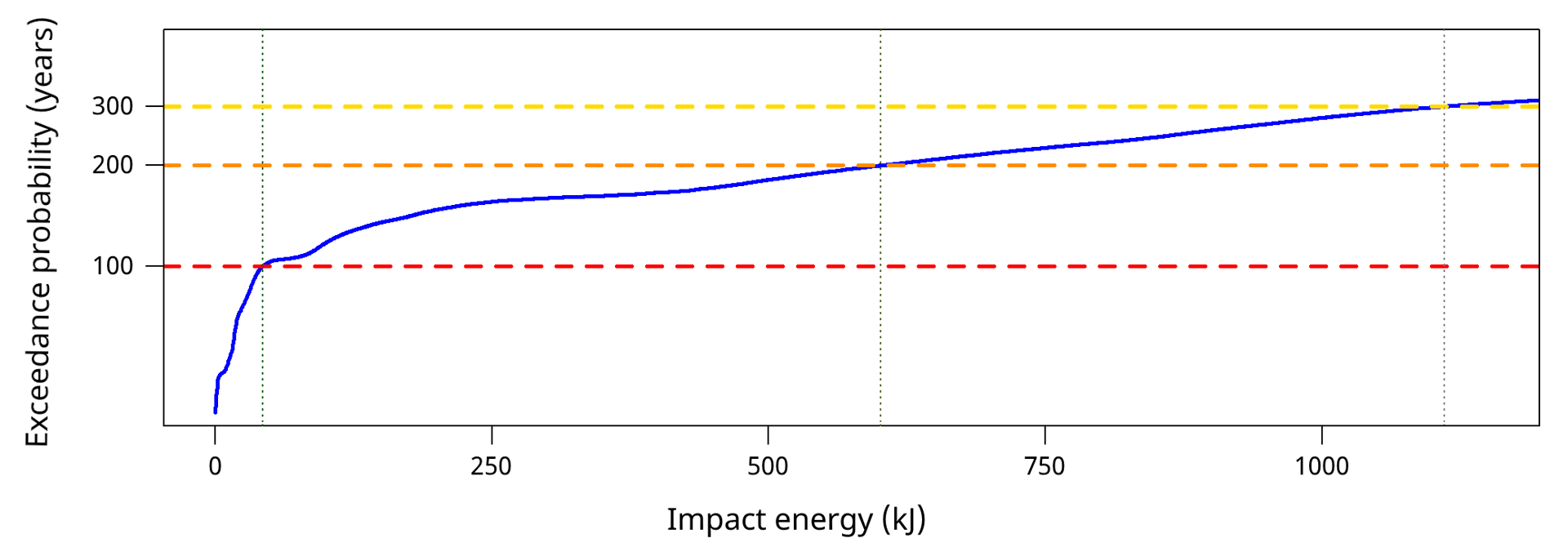
When a mountain road needed to be shifted closer to a steep, rockfall-prone slope, the design of new bridge piers hinged on one question: how much impact energy should each pier be built to withstand? Conventional rockfall assessments estimate how often a rock mass is triggered and how far it can travel, but they don't capture how likely a rockfall is to actually hit a specific, narrow target like a pier. We developed a probabilistic method that combines millions of 3D rockfall trajectory simulations, run across multiple source zones and block-size classes, with the geometric hit probability at each individual structure. Weighting every simulated trajectory by its release frequency and impact likelihood produces a full frequency-energy curve for each pier, shown here as return period versus impact energy, from which the design energy for any target return period, such as 300 years, can be read off directly. Applying the method to two nearby piers revealed impact energies differing by more than tenfold, driven by subtle differences in position relative to rockfall-channeling gullies. Engineers came away with a defensible, return-period-specific design energy for each structural element, rather than a blanket worst case, enabling more targeted and cost-effective protective design.
Trusted by partners and clients across the globe










Trusted by partners and clients across the globe